
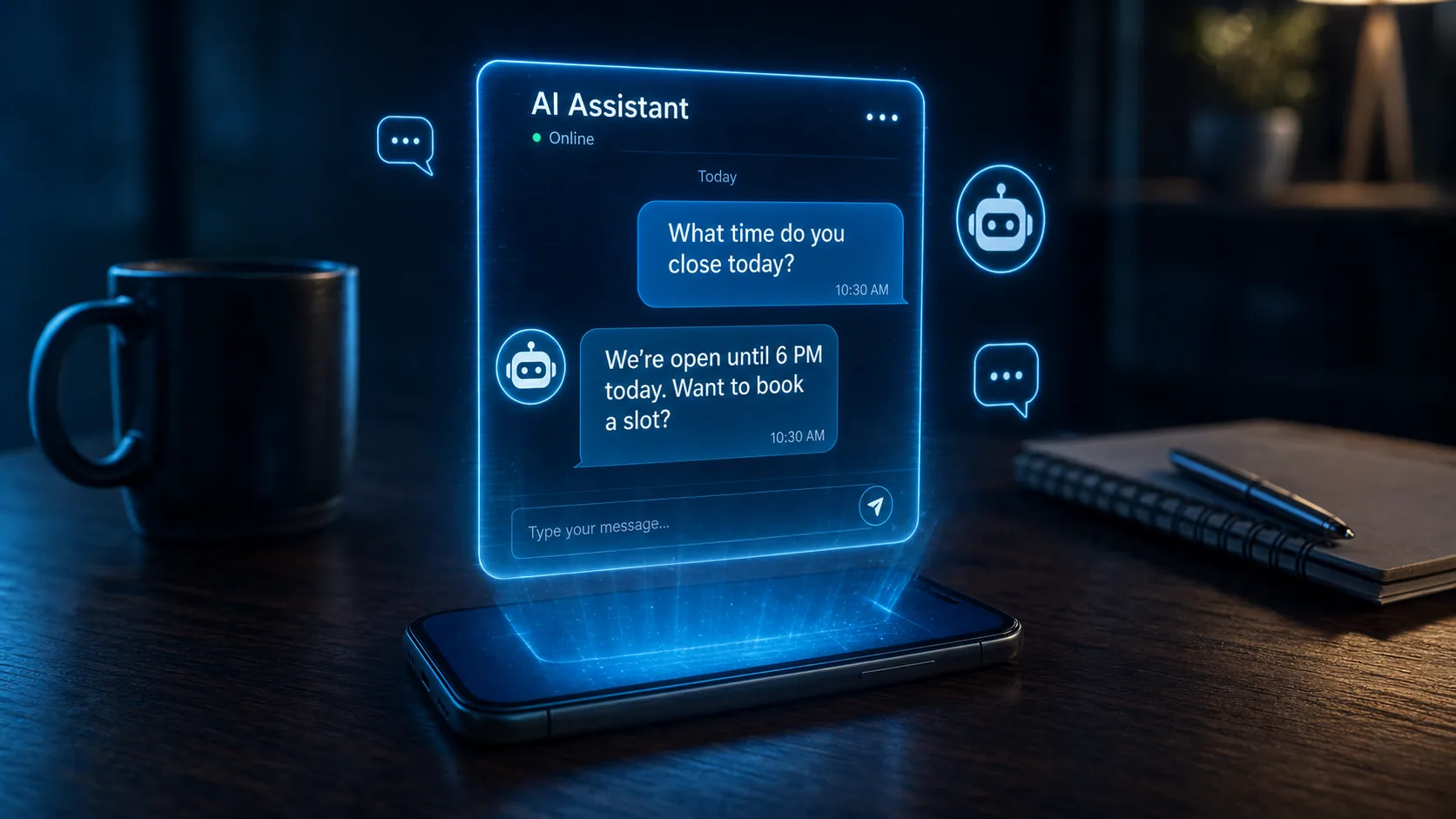
The chatbot in the corner of a website used to mean "this company has more money than sense." That changed around 2024. AI got good enough that a well-built chatbot can now answer real customer questions, book appointments, and screen leads at 11pm without anyone on staff. The pendulum has officially swung.
But "AI chatbot" still covers a huge range of quality. Some are genuinely useful. Some are still the same scripted decision trees in a fancier wrapper. Some frustrate every customer who tries to use them.
Here is the honest version of when a chatbot helps a service business, when it does not, and how to tell which one you would be getting.
Basic vs AI: there are two different things in this conversation
Before deciding if you want a chatbot, you need to know what kind you are talking about. There are two distinct categories:
Basic chatbots are rule-based. They answer a fixed set of questions you write yourself, with no surprises. If a customer asks something you have not pre-programmed, the bot says "I don't know" and offers contact info. The TMG site you are on right now uses one of these (look at the bottom-right corner).
AI chatbots use a language model in the background. They generate responses on the fly, trained on your business specifics, and can handle questions you have not pre-anticipated. They sound conversational, they can book appointments, and they cost more to run.
Most of the hype is about AI chatbots, but most service businesses actually just need a basic one. We sell both. We recommend basic to about three out of every four clients who ask about chatbots.
When an AI chatbot is genuinely worth it
There are four scenarios where an AI chatbot earns its monthly cost back in saved time:
- You get the same 20 questions over and over. "Do you offer X? Do you serve Y zip code? How much does Z cost?" An AI chatbot pre-trained on your services answers these instantly without you ever opening your inbox.
- You take after-hours bookings. Customers shop at 9pm. If your bot can collect their details and book them into your calendar, you wake up to a booked Tuesday morning instead of a "please call us" voicemail.
- You have a complex service menu. A 30-service salon, a multi-location HVAC company, an electrician with 12 specialties: AI helps customers find the right service without making them scroll a giant menu.
- You are paying for after-hours support somewhere else. If you currently pay a receptionist or virtual assistant to handle after-hours messages, an AI chatbot probably replaces 50% of their volume for a fraction of the cost.
If two or more of these apply to you, an AI chatbot is worth adding to your site. If none of them do, you are paying for theater.
When an AI chatbot makes things worse
The flip side is just as real. AI chatbots backfire when:
- They hallucinate. A bot that confidently quotes a price you don't actually charge, or commits you to availability you don't actually have, costs you trust and money. Cheap AI implementations do this constantly.
- They block the customer from a human. If a customer wants to talk to a person and the bot keeps redirecting them to articles, you have lost the booking and possibly the relationship.
- They sound like a chatbot. Generic "I'm here to help! What can I assist with today?" openers signal "this is not a human" before the customer has even asked anything. They scroll past.
- They are slower than just calling. If the bot takes 30 seconds to respond, the customer has already dialed your competitor.
Every TMG portfolio site with a chatbot has the bot configured to escalate to a human contact form or phone link within two messages if the customer wants out. That single rule prevents most of the worst experiences.
What a good service-business chatbot actually does
The shortlist of things a chatbot should do for a service business, ranked by ROI:
- Book appointments without making the customer leave chat. Embedded into the bot, not a "click here to book on Calendly" link.
- Answer the 20 most common pre-booking questions. Hours, location, service menu, pricing ranges, who handles what.
- Collect lead info when the answer is "we need to call you back." Name, phone, what they are asking about. Routed to your inbox or your CRM.
- Hand off cleanly to a human. A visible "Talk to a person" option from message one. No dark patterns.
You can see this in action on the demos at Halcyon Nail Studio (Halcyon Concierge), Coastline Cuts (Sal, the front-desk bot), and Meridian Climate (Will, the diagnostic assistant). Three different industries, three different bots, all following the same playbook.
How to know which one you need
A two-question test:
Do you currently lose more than five bookings a week because you cannot answer the phone or respond to messages fast enough? If yes, AI chatbot is probably worth it.
Are most of your customer questions answerable with a fixed FAQ? If yes, a basic chatbot is enough and cheaper.
If both are true, start with a basic chatbot and upgrade to AI later if your traffic justifies it. Most service businesses we work with land here. The basic version covers most of the value at a fraction of the cost.
FAQ
What does an AI chatbot cost?
It is scoped as part of your build, since a bot trained on your business and embedded directly into your site is not a flat menu item. See our Pricing page to see how we scope it in. Standalone services like Intercom or Drift charge $80 to $500 a month depending on volume, and you have to wire the training and embed yourself.
Will customers actually use the chatbot?
The ones who would otherwise leave without contacting anyone, yes. Roughly 20 to 30% of website visitors who do not call or fill out a form will engage with a chatbot if it is visible and well-designed.
Can an AI chatbot replace my receptionist?
For after-hours and overflow, mostly. For the actual relational, judgment-call work a good receptionist does, no. Best as a complement, not a replacement.
What happens when the AI chatbot does not know an answer?
It should hand off to a human immediately, either by routing to your contact form or showing your phone number. Bots that try to bluff are the bots that lose you customers.
How long does it take to train an AI chatbot on my business?
For our setup, about a week of light back-and-forth: you provide your services list, pricing, hours, common questions, and policies. We do the actual configuration and testing. Then it goes live.