
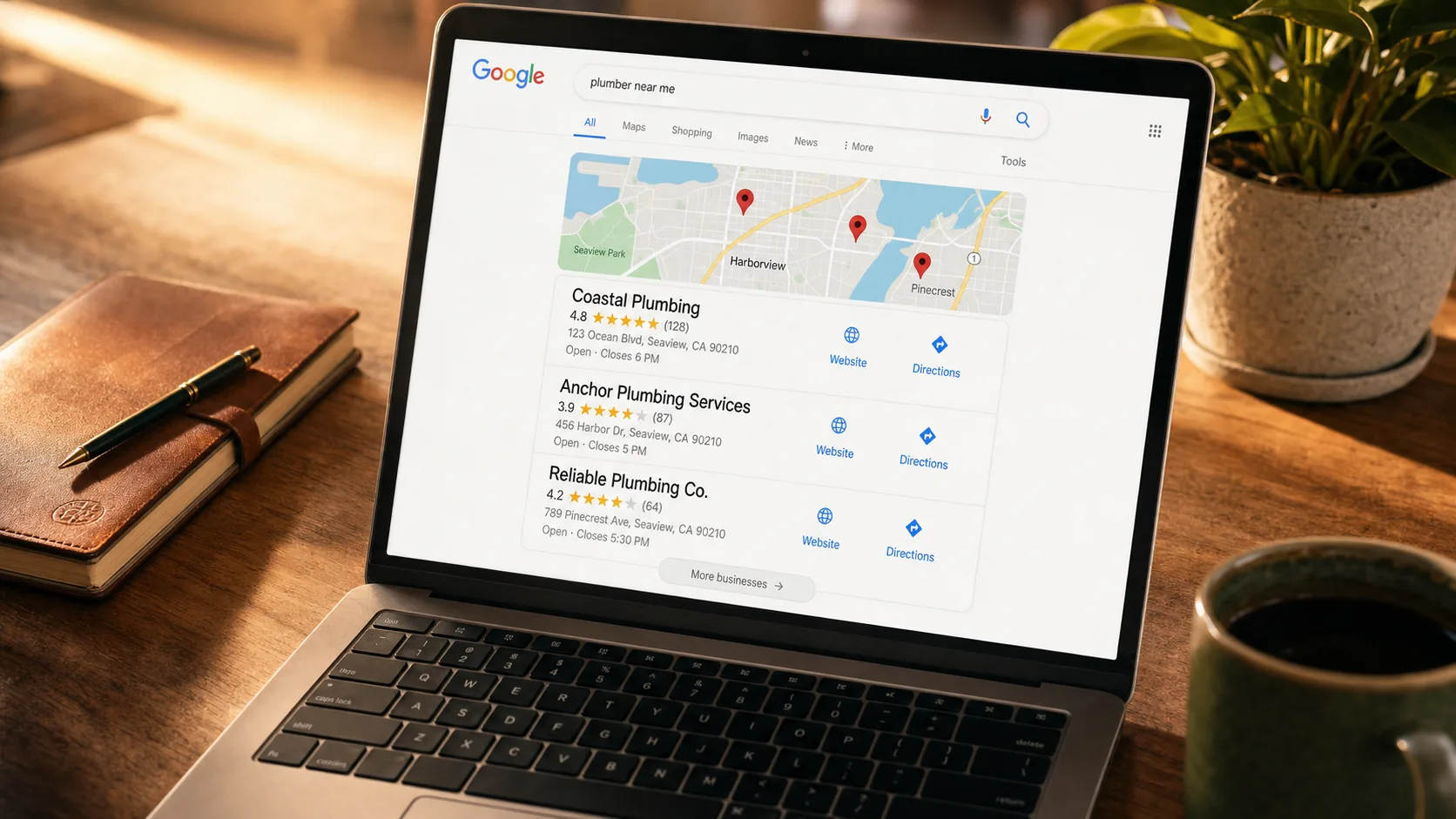
When someone searches "plumber near me" on their phone, Google shows them three businesses in a little box with a map. That box gets the vast majority of the clicks. Everything below it (blue links, paid ads, your competitor's blog post from 2019) fights for the scraps.
The box is called the local map pack, and ranking in it is the single highest-leverage thing a service business can do online.
This is the playbook.
The map pack is the game now
Twenty years ago, "SEO" mostly meant getting your blue link to show up on page one of Google for a specific keyword. That world still exists, but for a service business, it is a distraction.
Today, when someone in your service area searches for what you do, the result they see is dominated by three things:
- A map with three local businesses pinned (the map pack)
- Sometimes a paid ad above it
- Then the regular blue-link results below
If you are not in the map pack, you might as well not exist for that search. The customer doesn't scroll. They tap one of those three businesses, look at the reviews, and either call or move on. The whole interaction takes maybe 15 seconds.
Local SEO is the discipline of getting your business into that three-pack.
How Google scores you (the three factors)
Every conspiracy about Google's algorithm aside, the company has publicly said local rankings come down to three things:
Proximity. How close your physical business is to the person doing the searching. You can't fake this. But you can decide which city you list yourself in, and how widely your service area is set.
Relevance. How well your business matches the search. This is mostly about your Google Business Profile categories, your business name (don't keyword-stuff it), and the words on your website.
Prominence. How visible and trusted your business is to Google. This is the bucket that holds reviews, citations (mentions of your business on other sites), backlinks, photos, and signals from your own website.
You can't move your shop closer to every customer, so proximity is mostly fixed. The two levers you can pull are relevance (categories + content) and prominence (reviews + citations + on-site signals).
Your Google Business Profile is the foundation
If you do nothing else after reading this article, do this:
Claim and fully fill out your Google Business Profile. Not 60% filled out. Not "good enough." Fully filled out, with every field populated, every photo uploaded, every service listed.
Specifically:
- Primary category should match what most of your customers are searching for. Be precise. "Plumber" beats "Plumbing Contractor" if your customers say "plumber".
- Service area should match where you actually serve. Don't claim 30 cities. Google penalizes that.
- Photos should be real, recent, and plentiful. Exterior, interior, team, work in progress, finished work. Google reads photo metadata and shows the freshest ones first.
- Services should be added one by one with real descriptions, not a single "services" listing.
- Posts should go up at least monthly. They show up in your profile and signal activity.
- Q&A should be seeded by you (most owners don't realize they can do this).
A completely filled-out profile beats a half-filled one by a wide margin. Businesses we work with have moved up the map pack quickly after this step alone.
Reviews compound faster than anything else
After your profile is dialed in, reviews are the next biggest lever. Specifically:
Quantity. More reviews than your closest competitor, period.
Velocity. Steady flow over time beats a sudden burst followed by silence. Google notices both.
Recency. A review from this month outweighs one from 2019.
Response rate. Reply to every single one (good and bad). The reply is part of the listing.
The fastest way to compound reviews is to systematize the ask. After every job, after every appointment, send a text or email with a one-click link to your Google review page. Most customers will leave a review if you make it that easy. Most of your competitors don't ask.
We bake this kind of review automation into our Local SEO Pro Package add-on, but you can DIY it with any text messaging tool you already use.
On-site signals: the quiet half of local SEO
A lot of map-pack ranking happens on Google's side, but your own website does part of the lifting too. The signals Google looks for:
- NAP consistency. Your business name, address, and phone number need to match exactly across your website, your Google Business Profile, and every directory listing. Different abbreviations or formats break the signal.
- Local schema markup. A small block of structured data on your site that tells Google "I am a LocalBusiness, here is my address, here are my hours, here is my phone." Most sites are missing it.
- A real location page. Even single-location businesses benefit from a dedicated page with the address embedded, a Google Maps iframe, photos of the location, and your service area listed.
- Mobile speed. A slow site quietly drops you in rankings because Google measures Core Web Vitals from real-user data.
If your current site is missing any of these, that is what we wrote about in our piece on what a modern service business website actually needs in 2026. The two articles overlap on purpose. Your site and your map pack listing have to operate as one connected signal.
FAQ
How long does local SEO take to work?
For a fully claimed Google Business Profile with steady review velocity, expect noticeable map pack improvement within 60 to 90 days. Going from invisible to position one can take longer, depending on your competition.
Do I need to pay for ads on Google to show up?
No. The map pack is organic. Paid ads sit above it but cost per click, and most customers skip them.
What if my competitors all have hundreds of reviews and I have ten?
You catch up over time, but the gap is real. The fastest accelerant is asking every single customer for a review after each job, with a one-click link. Most businesses do not do this.
Can I do all this myself?
Yes, all of it. It is mostly persistence and consistency, not technical skill. The hard part is keeping it up over time while running the rest of your business.
Does my website actually matter, or is it all Google Business Profile?
Both. The profile carries more weight, but the on-site signals (schema, NAP consistency, location page, speed) are how Google verifies that your profile claims are real.